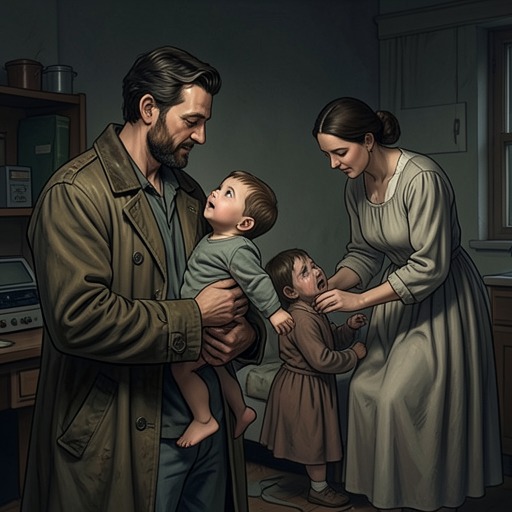
Bill Furlong and Ned’s Relationship
Small Things Like TheseBill Furlong and Ned’s Relationship grows inside the household that sheltered Furlong from infancy: Ned is the farmhand who shares its daily life and, over time, becomes one of the people whose care has helped make Furlong’s life possible. Yet the bond is shadowed by uncertainty about whether they are related. The story leaves that question unanswered, making Ned’s concrete acts of attention—rather than a proven family tie—the relationship’s defining fact.
Life in Mrs Wilson’s Household
Furlong’s mother was sixteen and working as a domestic for Mrs Wilson when she became pregnant. After her own people rejected her, Mrs Wilson allowed her to remain at work; she arranged for the mother and baby to be taken to hospital and brought home. Ned was already living in the household as its farmhand. Furlong spent his infancy there, first in a Moses basket in the kitchen, then in a large pram beside the dresser, among the serving plates and blue jugs that would persist in his memory.
The household’s ordinary arrangements placed Ned near Furlong from the beginning, though the account distinguishes his role from Mrs Wilson’s direct care. She gave the boy small tasks and helped him learn to read; Ned worked the farm, where the animals were well tended and the land carefully managed. Religious difference did not create much friction in the house. On Sundays, Ned drove Mrs Wilson to church, then continued a little farther with Furlong’s mother and child to the chapel. The prayer books and Bible were left on the hallstand until the next Sunday or holy day. This matter-of-fact routine locates Ned within a household that accommodated both women’s religious practice without making it a source of conflict.
Care as a Daily Practice
Years later, Furlong recalls Ned describing the household not as a place of wealth but as one where people were looked after. Ned remembered Mrs Wilson visiting the infant daily, never speaking cheaply of Furlong’s mother or taking advantage of her, and ensuring that those under her roof had food. He also described his own small room as being treated like a home of his own: nothing was disturbed, and he could get up at night and eat his fill if he wished. His recollection makes care tangible through shelter, food, privacy, and reliable conduct rather than grand declarations.
Ned’s place in Furlong’s life continued beyond childhood. He welcomed the adult Furlong into the kitchen, reminisced about the boy in the basket, and stayed talking with him late into the evening. Furlong remembered going to Mass and eating with Ned, and sitting up talking by the fire. Ned had polished his shoes and tied their laces, bought him his first razor, and taught him how to shave. These repeated acts give their closeness a distinctly practical texture: Ned helped Furlong learn the ordinary skills by which a boy becomes a man.
Uncertain Kinship and Shared History
During one visit, Furlong asked Ned who his father was. Ned said Furlong’s mother had never told him. He recalled that, in the summer before the birth, many of the Wilsons’ relations and friends had come over from England; they were fine-looking visitors who hired a boat to fish for salmon on the River Barrow. Ned could not say which of them, if any, was Furlong’s father. The account offers possibilities, not an identification, and leaves Furlong without a settled answer about his paternal origins.
The uncertainty later acquires a physical suggestion when a woman at Wilson’s remarks that she can see a likeness and asks whether Ned is Furlong’s uncle. Furlong cannot answer. Looking into the kitchen, he sees the blue jugs and serving plates much as they had been, while the floor has changed to lino. The familiar room holds both continuity and the unanswered question: its objects confirm the persistence of memory, but they cannot establish a family connection.
At the barber’s, Furlong studies his reflection for a resemblance to Ned and finds that he both can and cannot see one. He considers that the woman may have imagined the likeness, but the possibility does not seem easy to dismiss. More important to his understanding is Ned’s conduct after Furlong’s mother died: Ned had been downhearted, and their shared meals, Mass-going, and late conversations now seem to Furlong to form a pattern of attachment. He wonders whether Ned’s steady care helped him believe he came from finer stock. This remains Furlong’s interpretation, not a disclosed secret about Ned’s intentions; the relationship’s truth lies securely in what Ned did, even where its genealogy does not.
Moral Inheritance
The recollection of Ned occurs alongside Furlong’s growing recognition of the hardship surrounding the convent. His wife, Eileen Furlong, argues that he was raised far from hardship and that the convent’s girls are not their concern. Later, when Furlong pauses beside a girl who has been left with nothing before her, he offers to help; she begins to cry. As he walks with her, he asks himself whether a life can pass without someone finding the courage to go against what is happening and still be called Christian. The episode connects his present action to a past formed by other people’s care, without suggesting that Ned directed or caused his decision.
Furlong also thinks of Mrs Wilson’s daily kindnesses and of what her protection meant for his mother. Had she not kept the young woman in her household, Furlong reflects, his mother might have ended up in the very place from which he is now helping a girl. In this comparison, Ned’s remembered care belongs to a wider inheritance of attention: the meals, lessons, conversations, and small acts that kept Furlong secure are set against the abandonment he encounters elsewhere. Their relationship is not resolved by discovering whether Ned is an uncle. It is made legible instead through the durable evidence of a life watched over, and through the possibility that receiving care has helped Furlong recognize when another person needs it.